Scrutiny Beyond the Siren: Muslim Residents and the Rooms Where Policing Is Reviewed
A stop-and-search encounter can last four minutes. The paperwork it generates may be reviewed months later, in a council chamber or a police headquarters meeting room, by a small group of volunteers who never meet the person searched. That gap — between the pavement and the panel — is where a quiet but consequential form of public accountability takes place. It is also where Muslim Britain is, for the most part, still absent.
Community scrutiny panels are not new. For more than a decade, police forces in England and Wales have convened volunteers to examine stop-and-search records, body-worn video footage, complaints and use-of-force reports. The panels are generally advisory rather than disciplinary. They cannot overturn a search or uphold a complaint. But they can ask the questions that internal review processes are prone to skip: was the grounds recorded before or after the search? Was the explanation given to the young man on the street the same as the explanation written on the form? Did anyone ask whether he understood what was happening?
What the panels actually do
The precise format varies by force. Some panels meet monthly; others quarterly. Some concentrate on stop-and-search; others examine the use of force, Taser deployment, or the handling of public complaints. Many now view body-worn camera footage alongside the written record. Members usually receive training on the legal framework — chiefly the Police and Criminal Evidence Act 1984 for suspicion-led searches and Section 60 of the Criminal Justice and Public Order Act 1994 for suspicionless searches authorised in anticipation of serious violence — and on the limits of their role.
The panels sit within a broader accountability architecture. Police and Crime Commissioners are responsible for holding chief constables to account; Police and Crime Panels scrutinise the commissioners. The Independent Office for Police Conduct investigates the most serious complaints. Community scrutiny panels occupy a different space: they are closer to the ground, less formal, and, at their best, more conversational. They are also non-statutory, which means their influence depends heavily on the willingness of senior officers to listen and the persistence of the volunteers who attend.
Official statistics continue to show that Black people are stopped and searched at substantially higher rates than white people, with Asian people also stopped at elevated rates in many force areas. A significant proportion of searches result in no further action. Those figures are debated in Parliament and in the press. Less often are they examined by the people most affected, in a room where an officer's supervisor is present and expected to respond.
A seat at the table, not a tick-box
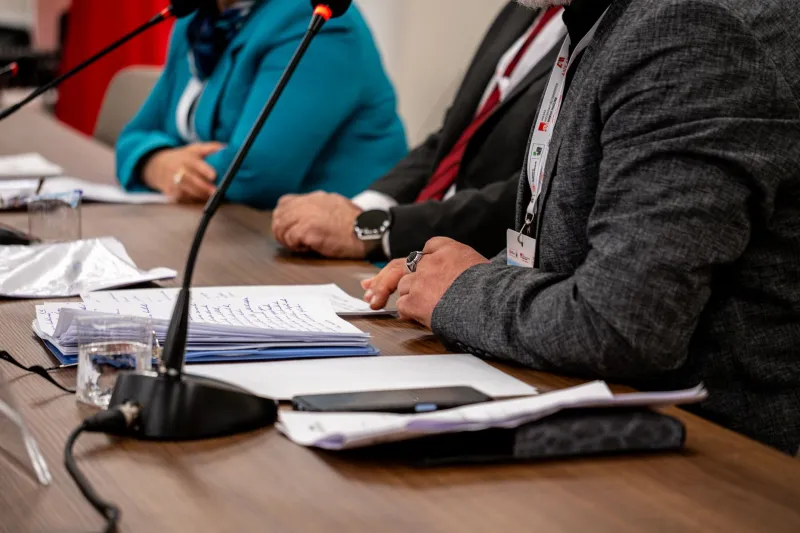
One panel member in the West Midlands, who asked to be identified only as Sana, joined a force scrutiny panel in 2024 after a family member was searched outside a mosque. She described the first meeting as “strange and ordinary at the same time” — a row of chairs, a stack of files, a superintendent taking notes.
What struck her was the detail. “You read a form that says ‘suspicious behaviour’ and then you watch the footage and you think, what was suspicious? He was walking,” she said. “I asked the question and there was a pause. Then the officer said it was a good question. That pause is why you go back.”
Sana is careful not to overstate the panel's power. She has seen recommendations accepted and recommendations quietly shelved. She has also seen the tone of the room change when a panel includes people who have been stopped themselves, or whose children have. “It is not about being angry,” she said. “It is about being specific. If you can say, ‘on page three, the grounds appear after the search began,’ that lands.”
How nomination works in practice
There is no single national application form. In most areas, panels are co-ordinated by the force's community engagement team or by the Office of the Police and Crime Commissioner. Some advertise vacancies openly; others recruit through existing community networks, which is precisely how representation drifts towards the already-connected.
For mosques, supplementary schools and civic organisations, the practical route is usually a short letter or email to the force scrutiny co-ordinator and the commissioner's office, asking about current membership, terms of reference and the nomination process. It is worth asking three questions at the outset: what training is provided, whether travel and childcare costs are reimbursed, and how the panel's recommendations are reported back.
Nomination should not mean sending a single person to speak for a diverse community. A panel that includes one Muslim volunteer and treats that person as the voice of all Muslims is not scrutiny; it is decoration. Better practice is to nominate two or three people with different experiences — a parent, a student, a professional — and to ensure they are supported rather than isolated.
The usual checks apply. Volunteers should expect a vetting process appropriate to the role and a confidentiality agreement covering case material. Meetings are often held in the evening, which suits many working people but can clash with prayer times or family responsibilities. Groups negotiating participation should raise this early; several forces have adjusted timings and provided refreshments in response to reasonable requests.
Making participation count
Attendance alone changes little. The panels that exert influence tend to share certain habits. They ask for aggregate data as well as individual cases. They track whether previous recommendations were implemented. They build relationships with the force's scrutiny lead rather than treating each meeting as a fresh confrontation. And they report back to the communities that nominated them, in plain language, so that participation is accountable in both directions.
There is a legitimate critique to be made: advisory panels can absorb energy that might otherwise go into formal complaints, legal challenges or political campaigning. They can also lend legitimacy to practices that communities believe are unjust. Those risks are real, and they are best managed by volunteers who understand the limits of the role and who maintain links with organisations outside the room.
Yet the alternative — leaving the review of policing to those already inside the system — has its own costs. The records examined in these meetings shape how forces train officers, allocate resources and interpret their own conduct. A community that is absent from that process should not be surprised when its concerns are described as unexplained.
A quiet form of power
The panels will not transform policing on their own. They are one modest mechanism among many, and they depend on good faith from forces that do not always display it. But they are accessible, they are local, and they are, in most areas, under-subscribed.
For Muslim civic groups looking for a practical entry point into public life in 2026, the scrutiny panel is an unusually concrete one. It requires no election, no large budget and no national campaign. It requires a nomination, a commitment to read the papers, and the willingness to ask, politely and repeatedly, why a four-minute encounter produced the record it did.